

How Decision Styles shapes better judgement
BeTalent Decision Styles helps organisations improve the quality, pace and clarity of decision-making by making individual and team decision preferences visible.
Grounded in rigorous research, the tool gives leaders a shared language for understanding how decisions are made, where teams get stuck and how to flex their approach to the decision in front of them.
This page offers a compilation of our work on BeTalent Decision Styles: the science, the models, the tools, and the evidence of impact.
Everything is grounded in rigorous research and designed to help organisations create environments where people can perform at their best.
BeTalent Decision Styles is a scientifically validated workplace assessment

"By delineating decision-making responsibilities based on strategic importance, consensus or delegation, we were able to streamline our workflow and promote accountability at all levels."
— Jilly Calder, Senior Vice President Human Resources UK & Europe, AtkinsRéalis
Why understanding decision styles matters
Good decisions do not come from finding the “right” answer alone. They come from having a sound process.
When individuals understand their own decision-making tendencies and how those tendencies show up within a team, they are better able to decide how to decide.
That means asking:
Who is best placed to own this decision?
Who needs to be consulted, challenged or informed?
What level of evidence, pace, risk or involvement does this decision require?
By making these preferences visible, teams can move away from habit, assumption and repeated debate. They can match the approach to the decision in front of them, reduce unnecessary friction and move forward with greater clarity.
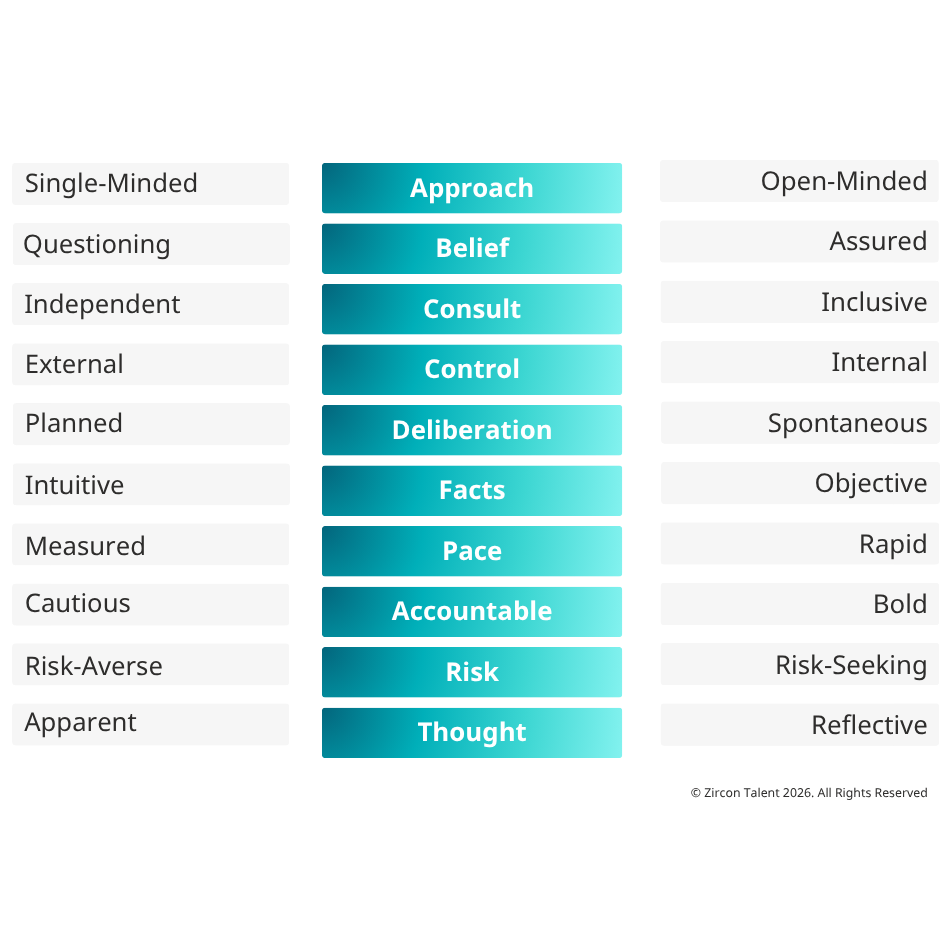
How the BeTalent Decision Styles model works
Each of the ten Decision Styles scales measured by the BeTalent tool reflects a preference, not a competence. Scores are compared to a robust norm group using Sten scores (1–10).
Low isn't bad and high isn't good, there are simply different, equally valid ways to decide.
We can use these scales to build a shared language. This creates greater clarity and consistency in how decisions are approached across individuals and teams, helping them adapt their approach to the situation in front of them.
How the adaptive scales work
Each BeTalent Decision Styles Scale include an adaptive space in the middle. This is not always ‘the best’ place to sit, but a zone where individuals may be more able to flex their approach to fit the needs of the decision.
The remaining 6 are:
belief- balanced
control - pragmatic
deliberation - considered
accountable - responsible
risk - opportunistic
thought- reasoned
Decision Styles in teams
At team level, Decision Styles helps reveal where people cluster, where different perspectives exist, and where greater flexibility may be needed. This makes cognitive diversity easier to see and easier to use.
The aim is not to remove difference, but to understand how different decision preferences can strengthen judgement, pace, challenge and ownership.
What this looks like in practice:
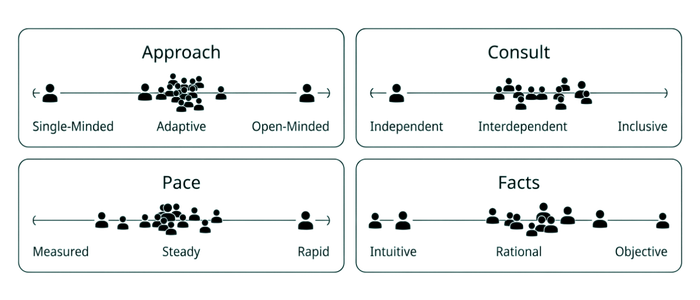
Self-awareness
Know your default pattern, and when to step past it under pressure.
Team balance
Spot over-representation, and invite the styles a decision is missing.
Contextual agility
Match the style to the situation, not a single default.
Download a sample report
Download a sample Decision Styles report to see how the tool helps individuals understand their decision-making preferences, recognise their potential watch-outs and build a more deliberate approach to judgement, pace, risk and collaboration.
“The real value of Decision Styles is that it gives leaders language for something they are already wrestling with. How do we make better decisions together? When you look at the profile of a whole leadership team, you can see the patterns, the tensions and the gaps. That visibility helps teams decide how to flex, without losing what makes them strong.”
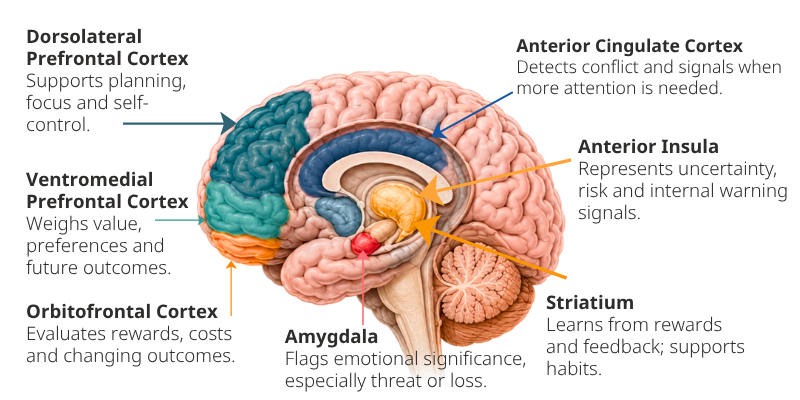
Key Brain Regions in Decision Making
Decision making relies on connected brain networks. The brain is constantly balancing competing signals: evidence and emotion, risk and reward, certainty and ambiguity, speed and control. These same tensions show up in the way people make decisions at work. Some people naturally seek more data, others move through intuition. Some pause to manage risk, while others act quickly to seize opportunity. Understanding these preferences gives individuals and teams a clearer way to recognise their default patterns, and to choose a more deliberate approach when the decision demands it.
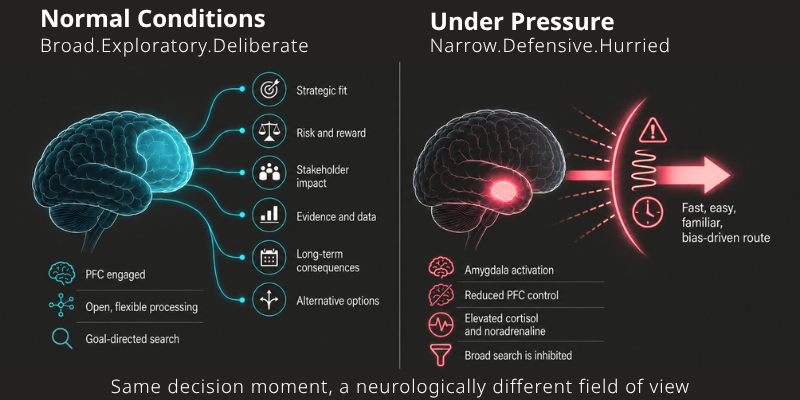
The decisive brain under pressure
As stress increases, the prefrontal cortex, which supports reflection, planning and flexible thinking, can become less effective, while threat-sensitive systems become more dominant. The result is a narrower field of view, with attention drawn towards faster, easier and more familiar options. What may look like decisiveness can actually be a more defensive, bias-driven style of thinking, where broader exploration, challenge and careful judgement are inhibited.
Awareness of Decision Styles helps counterbalance this. When individuals understand their own default patterns, they are better able to spot when pressure is pulling them into habit, over-caution, over-consultation or unnecessary speed. In teams, this awareness becomes even more powerful because different styles can act as a useful counterweight. A rapid decision-maker may need a more reflective voice. A risk-seeking leader may need someone who tests consequences. A highly inclusive team may need someone to clarify ownership and pace.
By making these preferences visible, teams can protect themselves from narrow thinking and deliberately choose the approach the decision requires, rather than simply defaulting to the style that feels easiest under pressure.
Our Work with Decision Styles
Learn how other organisations have benefited from BeTalent Decision Styles Here are just a select few case studies showcasing our work.


Improving executive decision clarity
BeTalent Decision Styles helped the AtkinsRéalis executive team make its decision-making patterns more visible. By exploring how leaders approached pace, risk, evidence, consultation and responsibility, the team was able to clarify ownership, streamline processes and make decisions more effectively together.
Building decision capability in senior leaders
A global health technology organisation uses BeTalent Decision Styles to support executive selection, succession and development, helping leaders understand how they approach risk, evidence, pace and consultation.
Our CEO’s podcast takes a research-led, scientific look at how people, teams and organisations can use and understand psychology to be happier, healthier, more productive and more engaged.
Discover thought leadership on decision styles and subscribe to get the latest insights.
Thought Leadership Library
At BeTalent by Zircon, we’ve been researching effective decision making for years. Below is a compilation of our published research, thought leadership and additional resources to further your learning.
-
![]()
Mindfulness & Decision Making
BeTalent by Zircon whitepaper
Workplaces are becoming faster, noisier and more complex, yet leaders are still expected to make clear decisions with far-reaching consequences. This white paper explores whether mindfulness can help create the mental space needed for better judgement, using Decision Styles research to examine how being more present may influence the way professionals think, adapt and decide.
-
![A group of people of mixed ages, genders and ethnicities sit round a meeting table having a discussion. The image represents a cognitively diverse group of people and the links between resilient leadership, psychological safety and wellbeing]()
How does diversity impact the way people make decisions?
Amanda Potter
This article explores the personal factors that may influence our individual decision making approaches and how these findings could be utilised to create more diverse and successful teams.
-
![A man faces into the sunrise, his back towards us. There is abstract detail mimicking kintsugi pottery over his back. The text reads Building Resilience & creating psyhcological safety]()
How to Make Successful Decisions
BeTalent by Zircon whitepaper
Better decisions start with understanding how you make them. This practical white paper explores ten decision styles, including how people assess risk, use evidence, involve others and act under pressure. Download it to recognise your preferences, strengthen team decision-making and adapt your approach to different situations.
-
![]()
The impact of negative emotions and resilience on decision making and procrastination
Amanda Potter & Emily Willis
Research suggests that negative emotions play a key role in procrastination. Using the BeTalent Resilience and Decision Styles Questionnaires, we found that individuals who experience higher levels of negative emotion are more likely to question their decisions and demonstrate an external locus of control, both of which are associated with procrastination. This article explores the psychological mechanisms behind procrastination and why emotional regulation and decision confidence are critical for sustained performance.
-
![]()
Mindfulness and developing decision-making
Anna Kane
As workplaces become noisier and more complex, leaders need to make clearer decisions under pressure. This article explores the relationship between mindfulness and decision-making, asking whether the ability to pause, pay attention and stay present can help professionals think more skillfully when the stakes are high.




Click here to subscribe to Leading with Perspective, our LinkedIn Newsletter
-

The Neuroscience of Decision Making Under Pressure
By Kashaya Stewart
Pressure does not just test performance. It changes how people think. This article explores how stress can narrow judgement, reduce flexible thinking and pull decision-makers towards faster, easier and more familiar choices. Discover the neuroscience behind why better decisions depend on the conditions surrounding the decision-maker.
-

Raising the Bar for Talent Assessment in a Global Market
By Emily Willis
Why do we keep investing in decisions that are no longer working? This article explores the psychology and neuroscience behind sunk cost bias, and offers four practical strategies to help leaders recognise emotional attachment, reduce bias and create space for better, more objective decisions.
-
Diverse Perspectives on Decision Making
By Candace Reading
Interviews with five exceptional leaders across diverse UK industries exploring their personal approach to decision-making. Each approach, sheds light on how their unique style benefits their organisation.
Share the Decision Styles Resource Pack
Download our research, publications and case studies, all in one handy pack, ready to share with colleagues and stakeholders.

Wondering how to deploy Decision Styles in your team?
Get in touch to discuss your specific challenges and opportunities, and we’ll put our best minds on the case.